Kimchi. Kimchi is a traditional Korean dish made of seasoned vegetables and salt. Koreans eat it at nearly every meal. It can be fresh, like a salad, or it can be fermented. Although many people get a chill through their spine at the very mention of the Although the popularity of kimchi is still rising in the West, it is an ancient dish, dating about two. Preparing kimchi is fairly easy, but it does take a bit of time.
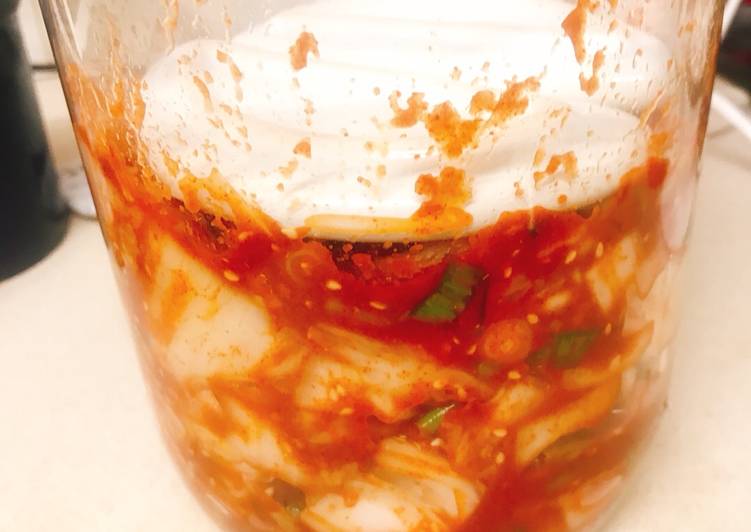 Open the jar briefly to let out the.
Get KIMCHI.finance (KIMCHI) price, charts, volume, market cap, exchange list and more.
Mak Kimchi, Cucumber Kimchi and Water Kimchi are some great easy ones that you can make at home.
You can have Kimchi using 19 ingredients and 16 steps. Here is how you achieve it.
Open the jar briefly to let out the.
Get KIMCHI.finance (KIMCHI) price, charts, volume, market cap, exchange list and more.
Mak Kimchi, Cucumber Kimchi and Water Kimchi are some great easy ones that you can make at home.
You can have Kimchi using 19 ingredients and 16 steps. Here is how you achieve it.
Ingredients of Kimchi
- It's 2 of Chinese leaf cabbages (I bought two of them and had about 900g for two.).
- Prepare 90 g of salt (10-12% of cabbage preferably sea salt).
- You need 450 ml of (10-12% of cabbage x 5) water.
- Prepare of [Sauce].
- Prepare 1/2-1 of apple (about 200-400g).
- It's 1/2 cloves of garlic (about 40g).
- You need of about 40 g Root ginger, skin peeled.
- You need 1 bunch of spring onion.
- Prepare of (option) 1/3 bunch of Chinese chives (nira), if you can get them. Cut into 3cm. If you do not have it, cut half of spring onion 3cm and the other half small.
- It's 50 ml of fish sauce (I could not get Korean 魚醤 in the UK.).
- You need 1-2 TBS of fine chilli powder (if Korean chilli, 3 TBS).
- Prepare 1-2 TBS of coarser chilli powder (if Korean chilli, 3 TBS).
- You need 2 tsp of sugar.
- Prepare of optional kelp Kombu.
- Prepare of optional niboshi.
- It's of [Optional vegetables].
- Prepare of Daikon radish.
- It's of cucumber.
- Prepare of carrots.
Kimchi is a traditional Korean dish of fermented vegetables, the most common of which are napa cabbage and daikon radish. In addition to being served as banchan, Korean side dishes presented as. Kimchi is a spicy side dish made from fermented vegetables and Korean red pepper, and is loaded with potential health benefits. It is a staple of the Korean diet, and its popularity has surged worldwide.
Kimchi instructions
- Cut Chinese cabbages into serving sizes. Traditionally, cabbages are not cutting into serving sizes and put sauces between leaves. However, this way is much easier to handle! So cut cabbages..
- Divid them into hard parts and tender leaves..
- Wash them under running water and drain them in a colander..
- In a big bowl or a big pan, sprinkle salt on to harder leaves and pour water. (The amount of salt is 10-12% of cabbage and water is 5 times of salt). Then put a plate and put something as a weight..
- Leave them for about 30 mins and add softer leaves. Then put plate and a weight on the top again. And leave it for another two and half hours or so..
- After three hours in total, rinse them under running water and drain them. Taste it. If it is too salty, put them in freshwater and get rid of salt a little bit. Make the salt level as Japanese asatzuke: not too salty but salty. Leave them in a sieve for about 3 hours in order to drain excess water. Or if you are in hurry, squeeze by hands and get rid of the excess water without waiting for three hours..
- While waiting for the cabbage to dry, make the sauce. (optional "dashi" stock) If you have kelp and niboshi, boil water. Pour over kelp and niboshi and leave until it becomes room temperature. This “dashi” will gives depths to Kimuchi. You only need 30ml (2 Tablespoon) for this but you and use rest for other dishes..
- Peel the ginger. Please use tea spoon to peel it. It is the safest and easiest way to peel ginger. Usually, Brtish people do not know about it. Peel the garlic as well..
- Cut spring onion. Half of them as small pieces and the other half about 3cm. If you have Chinese chives (Nira), please use them and cut Nira as 3cm and all spring onion small! Taste much better with Nira but I cannot find it here. You could get it in Japanese or Chinese supermarkets in London. You could also use normal chive instead as well..
- Try to use a finer chilli and a bit coarser chilli. But if you cannot find two types of chilli powders, just used one. Mix both chilli well in a bowl. If you use Korean chilli powder, use 3 tablespoons each as they are milder..
- Put peeled ginger, garlic and apple in a food processor. Make purée..
- Add all sauce ingredients, including the purée and "dashi" stock into a big bowl except the half of the chilli powders and mix them well. Please start with half of the chilli powder or less and add gradually the other half of chilli to suit your taste. If you add all at once it may be too hot for you and it would be impossible to be undone. You could add a small portion of your former Kimchi sauce or Kimchi to accelerate the fermentation..
- The beauty of homemade Kimchi is you can make as you like. You could add more garlic, ginger, apples, more spring onion, or add chives etc. You could add Kelp, niboshi or dried fish etc when you ferment it. So, play with your sauce and try to find your perfect Kimchi! And you can definitely make much tastier Kimchi than bought ones!.
- Then, add cabbage and mix them with hands with gloves. I use disposable plastic gloves. Then after mixing well, put them into a clean container. I use a Kilner fermentation bottle set which is great for Kimuchi..
- Leave it in a relatively cool place in the house for three days at least and it is ready to eat!.
- I could not get Korean fish saice 魚醤 but I was able to buy this from Ocado..
Borrowed from Korean 김치 (gimchi), derived from 침채 (chimchae) in the late Koryo dynasty. Doublet of kimuchi. kimchi (usually uncountable, plural kimchis). A Korean dish made of vegetables, such as cabbage or radishes, that are salted, seasoned. Kimchi Jjigae is one of the most iconic dishes of Korea. It is a staple in virtually all Korean Kimchi Jjigae is comfort food for virtually all Koreans.